Monday, 26th October 2026
To,
Shri Jagat Prakash Nadda Ji
Hon’ble Union Minister of Health and Family Welfare
and Chemicals and Fertilizers,
Government of India
Kartavya Bhawan -1, New Delhi -110001, India
Subject: Request for a Meeting to Present VataVriksh Parent Care’s Dementia-Care Model and Discuss the Development of a National Dementia Plan for India
Respected Shri Nadda Ji,
India is facing a growing dementia-care challenge that requires urgent and coordinated national attention. A nationally representative study published in Alzheimer’s & Dementia in 2023 estimated that approximately 8.8 million Indians aged 60 years and above were living with dementia. If prevalence remained unchanged, this number could reach approximately 16.9 million by 2036. These figures highlight the urgent need to strengthen India’s healthcare and social-care systems to address the needs of its ageing population.
Dementia affects far more than memory. It can progressively influence communication, behaviour, decision-making, independence and the ability to perform everyday activities. Its impact extends to families, caregivers, healthcare providers and society as a whole.
The burden of caregiving is also disproportionately borne by women. According to the World Health Organization (WHO), women provide approximately 70% of care hours for people living with dementia worldwide. Although this is a global estimate rather than an India-specific statistic, it highlights the significant responsibilities frequently shouldered by wives, daughters and daughters-in-law. Many caregivers must balance employment, household responsibilities and their own well-being while providing prolonged support to an older family member.
In this context, I wish to draw your kind attention to the need for a comprehensive National Dementia Plan for India and to present the practical experience of VataVriksh Parent Care, Gurugram, in senior care and dementia support.
A recent article published in The Sunday Times of India on 25 October 2026, titled “Why ageing India needs a dementia plan,” has further highlighted the importance of developing a structured national response to this growing challenge.
1. Why India Needs a National Dementia Plan
Families affected by dementia often face difficulties in obtaining timely assessments, understanding the progression of the condition, accessing trained caregivers and finding
appropriate long-term care. The lack of coordinated support can leave families managing complex care needs without adequate professional guidance, respite or financial assistance.
A National Dementia Plan could establish a coordinated framework connecting healthcare services, social-welfare programmes, specialised care providers, research institutions and community organisations.
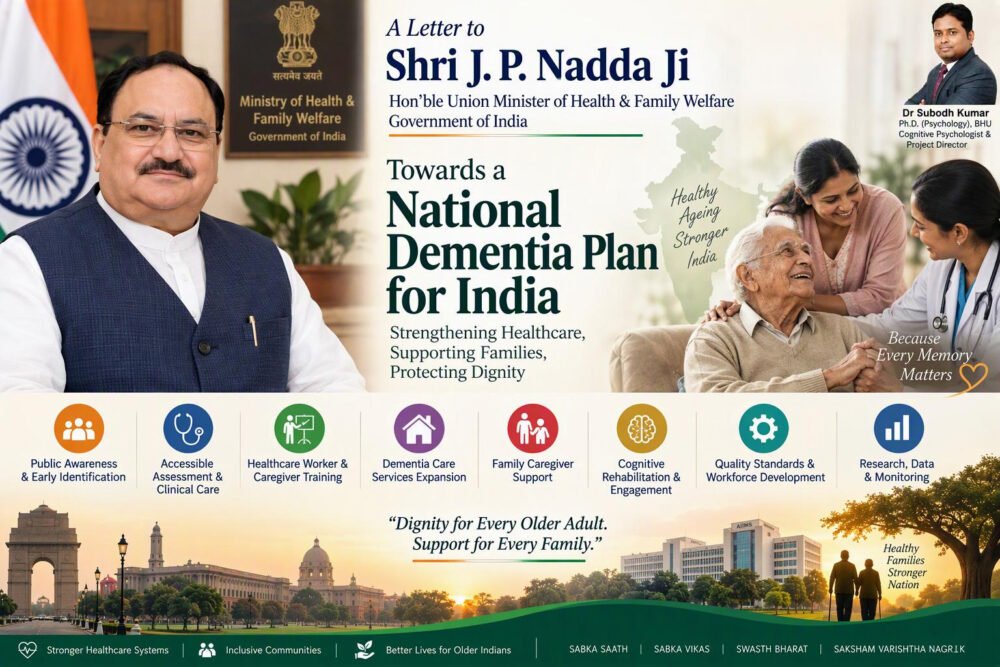
We respectfully propose that such a plan consider the following priorities:
a. Public awareness and early identification: Strengthen public understanding of dementia, reduce stigma and encourage timely assessment when cognitive changes become apparent.
b. Accessible assessment and clinical care: Improve access to appropriate cognitive assessments, diagnostic services, medical consultation, treatment and continuing care.
c. Training for healthcare professionals and caregivers: Develop structured training programmes for healthcare workers, professional caregivers and family members to improve their understanding of dementia and practical care requirements.
d. Expansion of specialised dementia-care services: Encourage the development of memory-care facilities, dementia day-care programmes, respite services and appropriate long-term care options.
e. Support for family caregivers, particularly women: Explore caregiver education, counselling, respite opportunities and social-support mechanisms to reduce the emotional, physical and financial burden of prolonged caregiving.
f. Rehabilitation and cognitive engagement: Promote appropriate cognitive stimulation, meaningful activities, communication support, mobility assistance and rehabilitation according to each individual’s abilities and care needs.
g. Quality standards and workforce development: Establish appropriate quality and safety standards for dementia-care services while strengthening the availability of trained personnel.
h. Research, data collection and monitoring: Support Indian research, improve the availability of reliable dementia-related data and evaluate the effectiveness of care programmes and interventions.
A coordinated approach involving the Ministry of Health and Family Welfare, relevant ministries, state governments, healthcare institutions, professional care providers and civil-society organisations could help make these priorities practical and sustainable.
2. VataVriksh Parent Care: Practical Experience in Dementia Support
At VataVriksh Parent Care, Gurugram, our work is guided by the belief that older adults deserve care that preserves their dignity, recognises their individual needs and supports their quality of life.
Our services include assisted living, memory care, dementia and Alzheimer’s care, senior day care, respite care, structured cognitive engagement, health monitoring and coordination of appropriate clinical and rehabilitative support.
Our approach recognises that effective dementia care must go beyond accommodation and physical assistance. It requires individualised care plans, meaningful activities, appropriate responses to changes in memory and behaviour, support with daily living and regular communication with families.
Through our practical work with older adults and their families, we have seen the importance of helping caregivers understand dementia-related changes and respond with patience, consistency and empathy. We also recognise that families need guidance throughout the caregiving journey, rather than assistance only during a crisis.
We believe that the experience of organisations working directly with older adults can provide valuable practical insights into the development of a national dementia-care framework.
VataVriksh Parent Care would welcome the opportunity to share its care model, operational experience and recommendations with the appropriate government officials and contribute constructively to this national priority.
3. Request for a Meeting and Government Guidance
With utmost respect, I request an opportunity to meet you or the appropriate officials nominated by your office to present the VataVriksh Parent Care model and discuss how practical experience from senior-care and dementia-care organisations could contribute to the development of a National Dementia Plan for India.
We would be grateful for your guidance on the appropriate department or institutional mechanism through which our recommendations may be formally submitted for consideration.
We would particularly welcome the opportunity to discuss:
- The development of a coordinated national framework for dementia awareness, assessment, care and caregiver support.
- Opportunities to strengthen collaboration between government institutions and experienced senior-care organisations.
- The potential role of specialised dementia-care facilities, day-care programmes and respite services in supporting families.
- Training and awareness initiatives for professional and family caregivers.
- Practical approaches to making dementia care more accessible, person-centred and sustainable.
Our intention is to contribute constructively to the national effort by sharing practical observations and recommendations based on our work with older adults and their families.
4. A Shared Responsibility Towards India’s Ageing Population
India’s demographic transition makes it increasingly important to prepare for the complex needs of older citizens. Dementia care must be recognised as a long-term public-health and social-care priority rather than a responsibility left entirely to individual families.
People living with dementia deserve understanding, appropriate care and the opportunity to live with dignity. Their families deserve reliable information, professional guidance and meaningful support.
A comprehensive National Dementia Plan could help bring these elements together, strengthen coordination between healthcare and social-care services, and provide a clearer framework for addressing the needs of people living with dementia across India.
At VataVriksh Parent Care, we remain committed to supporting older adults and their families through compassionate, person-centred care. We would be honoured to share our experience and contribute to discussions aimed at building a stronger dementia-care ecosystem in our country.
I sincerely request your kind consideration of this proposal and an opportunity to present our work to you or the appropriate officials of the Ministry.
Thank you for your time and consideration.
With highest regards,
Dr Subodh Kumar
(Ph.D. in Psychology, Banaras Hindu University)
Cognitive Psychologist & Project Director,
VataVriksh Parent Care
888, Saraswati Vihar, MG Road,
Gurugram – 122002, Haryana, India
Website: www.VataVriksh.com
Contact: +91 8285 82 6763