Monday, 26th October 2026
To,
Shri Narendra Modi Ji
Hon’ble Prime Minister of India
Prime Minister’s Office
Seva Teerth, New Delhi – 110011
Subject: Request for a Meeting to Present VataVriksh Parent Care’s Dementia-Care Model and Discuss a National Dementia Plan for India
Respected Sir,
India is facing a growing dementia-care challenge that demands urgent national attention. A nationally representative study published in Alzheimer’s & Dementia in 2023 estimated that approximately 8.8 million Indians aged 60 years and above were living with dementia. If prevalence remained unchanged, this number could reach approximately 16.9 million by 2036. Behind these figures are millions of older citizens whose memories, independence and everyday lives are affected, along with families who may face years of emotional, physical and financial responsibility.
The burden of caregiving is also deeply unequal. According to the World Health Organization (WHO), women provide approximately 70% of care hours for people living with dementia worldwide. Although this is a global estimate rather than an India-specific statistic, it highlights an important concern: wives, daughters and daughters-in-law often shoulder substantial caregiving responsibilities alongside employment, household duties and their own health needs. Without adequate training, respite services and professional support, these responsibilities can become overwhelming.
India must prepare not only to care for a growing population of people living with dementia, but also to support the families—especially women—who provide much of that care. Dementia is not merely a medical condition; it is a national public-health, social-welfare and family-support challenge requiring a coordinated, long-term response.
A recent article published in The Sunday Times of India on 25 October 2026, titled “Why ageing India needs a dementia plan,” brings this issue into sharp focus. It reinforces the need for a comprehensive national strategy that integrates early identification, appropriate clinical care, specialised support services, caregiver training and the protection of the dignity and rights of older citizens.
It is in this context that I wish to bring to your kind attention the work of VataVriksh Parent Care, Gurugram, and seek an opportunity to present our practical experience in senior care and dementia support.
Why India Needs a National Dementia Plan
Dementia affects memory, thinking, communication, behaviour and the ability to carry out everyday activities. Its impact extends beyond the individual to family relationships, household finances, caregivers’ physical and mental well-being, and the wider healthcare and social-care systems.
Despite the growing need, families may struggle to access timely assessments, reliable information, trained caregivers, structured cognitive engagement, respite care and appropriate long-term support. Care is often fragmented, leaving families to navigate complex and prolonged caregiving responsibilities with limited guidance.
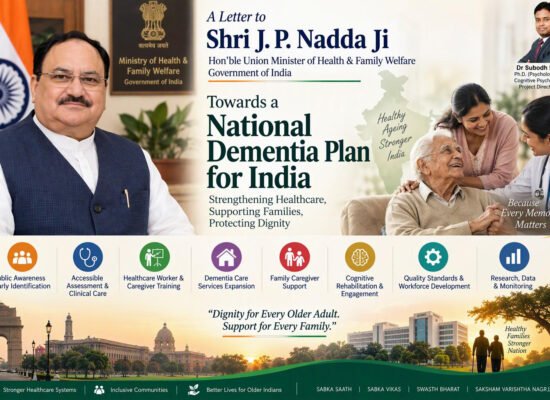
A comprehensive National Dementia Plan could help address these gaps by establishing a coordinated framework for prevention and risk reduction, early identification, diagnosis, treatment, rehabilitation, long-term care and caregiver support.
Such a plan could include:
- National awareness and early identification: Public education to improve understanding of dementia, reduce stigma and encourage timely assessment.
- Accessible assessment and clinical care: Better access to trained professionals, diagnostic services, appropriate treatment and follow-up.
- Dementia-friendly healthcare and communities: Greater awareness among healthcare providers, public institutions and community organisations.
- Training and support for caregivers: Practical training for family caregivers and professional care staff, with particular attention to the needs of women who provide substantial unpaid care.
- Expansion of specialised care services: Encouraging the development of memory-care facilities, dementia day-care programmes, respite services and appropriate long-term care options.
- Financial and social support for families: Exploring measures that make dementia care more accessible and reduce the financial and emotional burden on families.
- Quality standards and workforce development: Establishing appropriate standards for dementia-care services and strengthening the training of caregivers and other relevant professionals.
- Research, data and monitoring: Improving national data, supporting Indian research and evaluating the effectiveness of care models and interventions.
A national framework could bring together the Ministries of Health and Family Welfare, Social Justice and Empowerment, Women and Child Development, and other relevant institutions, along with state governments, healthcare providers, researchers, civil-society organisations and families affected by dementia.
VataVriksh Parent Care: Practical Experience in Senior and Dementia Care
At VataVriksh Parent Care, Gurugram, we work towards providing older adults with care that respects their dignity, individual needs, abilities and life experiences. Our approach recognises that senior care must extend beyond accommodation and physical assistance to include emotional well-being, meaningful engagement, cognitive stimulation, family communication and appropriate health support.
Our care services and programmes include assisted living, memory care, dementia and Alzheimer’s care, senior day care, respite care, structured activities, health monitoring and coordination of appropriate clinical and rehabilitative support.
Our experience has reinforced the importance of understanding dementia-related changes in memory, communication, behaviour and daily functioning. Families and care staff need guidance to respond with patience, consistency and empathy, while maintaining safety and respecting the individual’s dignity.
We believe that practical care models developed through day-to-day experience can contribute valuable insights to the design of a broader national strategy. Our work has also highlighted the importance of structured activities, individualised care plans, caregiver awareness and sustained engagement with families.
We do not view dementia care as the responsibility of families alone. It requires a supportive ecosystem in which families, trained professionals, healthcare providers, community organisations and public institutions work together.
Request for a Meeting and Guidance
With utmost respect, I request an opportunity to meet you (along with VataVriksh Parent Care team) or the appropriate officials nominated by your office to present the VataVriksh Parent Care model and share practical observations from our work in senior care and dementia support.
We would welcome the opportunity to contribute constructively to discussions concerning a comprehensive National Dementia Plan for India. We would also be grateful for guidance on the appropriate government ministry, department or institutional mechanism through which our experience and recommendations may be formally presented.
Our intention is to support a national effort that makes dementia care more accessible, organised, compassionate and sustainable. We believe that collaboration between the government, professional care providers, healthcare institutions, researchers and families can help develop solutions suited to India’s social, cultural and economic realities.
A National Responsibility Towards Our Elders
India has a longstanding tradition of respecting and caring for its elders. As the country’s population ages, this commitment must be supported by practical systems that enable older citizens to live with dignity, receive appropriate care and remain meaningfully connected with their families and communities.
People living with dementia deserve understanding rather than stigma, appropriate care rather than neglect, and dignity rather than exclusion. Their families deserve guidance, professional support and opportunities for respite.
A comprehensive National Dementia Plan would be an important step towards ensuring that no older citizen and no family has to face this challenge without adequate support.
I would be honoured to have the opportunity to present our work and discuss how VataVriksh Parent Care may contribute to this important national objective.
Thank you for your time and kind consideration.
With highest regards,
Dr Subodh Kumar
(Ph.D. in Psychology, Banaras Hindu University)
Cognitive Psychologist & Project Director,
VataVriksh Parent Care
888, Saraswati Vihar, MG Road,
Gurugram – 122002, Haryana, India
Website: www.VataVriksh.com
Contact: +91 8285 82 6763