Date: 29 September 2026
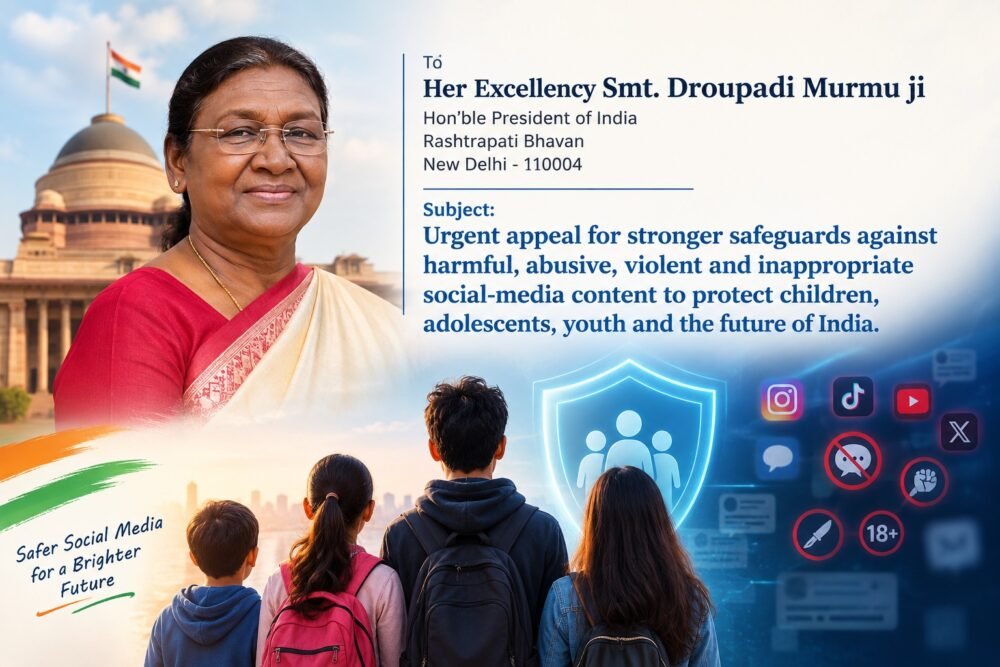
To
Her Excellency Smt. Droupadi Murmu ji
Hon’ble President of India
Rashtrapati Bhavan
New Delhi – 110004
Subject: Urgent appeal for stronger safeguards against harmful, abusive, violent and inappropriate social-media content to protect children, adolescents, youth and the future of India
Respected Madam,
I respectfully submit this representation before Your Excellency in the larger interest of the children, adolescents, youth and future generations of our country.
On 22 September 2026, while addressing the 72nd National Film Awards, Your Excellency highlighted the extraordinary influence that popular artists have on children and young people. You observed that when successful artists speak about disciplined lifestyles, millions of children and young people emulate them, and urged popular artists not to endorse products harmful to people’s health. You concluded with the powerful message that “A true star is the one who spreads light, not darkness.”
With utmost respect, I believe that this principle needs to be extended to the digital environment, which today has an influence on our children and youth that may be even more continuous and pervasive than traditional entertainment.
The emerging digital environment
Social media has become an integral part of everyday life. Children, adolescents, young people and adults consume reels, short videos, livestreams and other user-generated content for hours every day.
Social media has enormous positive potential for education, creativity, communication, entrepreneurship, employment and knowledge-sharing. However, the same platforms can also expose users to content that is abusive, sexually inappropriate, violent, humiliating, criminal, threatening or otherwise harmful.
The fundamental problem is that the user often does not know what the next video will contain.
A person may open a platform to watch an educational, humorous or harmless video, and within seconds the next recommended video may contain abusive language, extreme violence, sexualised material, bullying, humiliation, criminal activity or other inappropriate material.
The sequence is unpredictable.
The exposure can be continuous.
The content can be unfiltered.
And the recommendation system may continue presenting similar material once it detects that the user is engaging with it.
This is fundamentally different from many traditional environments in which parents, teachers or institutions have some ability to know what material a child is being exposed to.
Children and adolescents require special protection
The concern becomes particularly important when the user is a child or adolescent.
Adolescence is a developmental period involving curiosity, exploration, sensitivity to peer approval and attraction towards novelty and exciting experiences. UNICEF’s current work on adolescence notes that reward, excitement and social-approval systems develop earlier than the systems responsible for long-term planning and impulse control.
Therefore, it is unrealistic to expect every young person to consistently exercise adult-level judgement when confronted with an unlimited stream of highly engaging and increasingly sensational content.
There is an important distinction between a young person deliberately seeking appropriate information in a supervised or educational context and a platform repeatedly placing inappropriate material in front of that young person through an automated recommendation system.
Material that parents would not permit at home, teachers would not permit in a classroom and society would ordinarily consider inappropriate for children can nevertheless appear on a screen within seconds.
This issue deserves greater public discussion.
From occasional exposure to continuous exposure
The concern is not merely that a child may accidentally see one inappropriate video.
The greater concern is repeated exposure.
A child may initially encounter inappropriate material accidentally. Curiosity may lead to continued viewing. The recommendation system may then identify engagement with that material and provide more similar content.
In this manner, what begins as an accidental encounter can become a repeated pattern of consumption.
When this happens every day, the concern is no longer simply about one video. It becomes a question of the digital environment being created around the child.
We should therefore examine not only what content is uploaded, but also:
- what content is recommended;
- what content is repeatedly amplified;
- what content generates financial incentives;
- how quickly harmful material spreads;
- how frequently minors encounter such material; and
- what mechanisms exist to prevent repeated exposure.
The commercial incentive requires attention
Another aspect deserves serious consideration.
Content creators are often rewarded for views, engagement, followers and watch time. Platforms also compete for users’ attention.
This can create an environment in which sensational, shocking, controversial or provocative content may receive greater attention and wider circulation.
I respectfully submit that commercial success should not become a reason for technological systems to amplify material that is harmful to children or society.
If a platform can use sophisticated Artificial Intelligence to recommend videos that are likely to keep a person watching, it should also be capable of using comparable technological capabilities to identify and reduce the circulation of clearly unlawful or seriously harmful material.
Technology should not merely optimise engagement.
It should also optimise safety.
Normalisation of harmful behaviour
There is another long-term societal concern.
When people repeatedly see violence, humiliation, criminal acts, abusive language, cruelty, sexualised behaviour or other harmful conduct presented as entertainment, there is a possibility that repeated exposure may reduce the perceived seriousness of such behaviour for some viewers.
More importantly, repeated exposure to such reels and videos can influence the way people perceive their surrounding world. When something is repeatedly shown on a screen, again and again, the human mind may gradually begin to perceive that behaviour as familiar, ordinary or “normal”, even when that behaviour would not ordinarily be accepted in the home, school or wider society. What may initially appear shocking, unacceptable or unusual can, through repeated exposure, begin to feel commonplace.
This is particularly concerning for children, adolescents and young people, who are still developing their understanding of social norms, acceptable behaviour and the consequences of their actions. If harmful, abusive, violent or inappropriate behaviour is repeatedly presented as entertainment, a concern arises that the boundary between what is socially acceptable and what is unacceptable may gradually become blurred for some viewers.
We therefore need to ask not only, “What are people watching?” but also, “What are people gradually learning to consider normal because they are watching it repeatedly?”
I am not suggesting that watching such a video automatically causes a person to commit a crime. Such a conclusion would require careful scientific evidence.
However, the possibility that repeated exposure can influence attitudes, perceptions of social norms, imitation and desensitisation deserves systematic research and public-policy attention.
We should not wait until harmful digital behaviour produces visible social consequences before taking preventive measures.
Crime and violence should not become entertainment
There is increasing availability of videos showing actual or alleged criminal incidents, CCTV footage, physical assaults, fights, humiliation, abuse and other disturbing events.
Some such material may have legitimate journalistic, evidentiary, educational or public-interest value.
However, there is a fundamental difference between responsible reporting of a crime and presenting graphic violence or criminal behaviour primarily for entertainment, attention, shock value or monetisation.
The latter should not be allowed to become a normal component of children’s and young people’s daily entertainment environment.
The impact extends beyond children
This is not exclusively a children’s issue.
Adults are also exposed to the same environment. Parents, teachers, professionals and older people can also be affected by misinformation, abusive material, graphic violence, scams, manipulated media and other harmful content.
Therefore, the objective should be to create a safer digital ecosystem for society as a whole, while providing enhanced safeguards for children and adolescents.
A national opportunity through Artificial Intelligence
India is rapidly advancing in Artificial Intelligence and digital technology.
This provides an extraordinary opportunity.
AI systems can increasingly analyse:
- speech and language;
- multiple Indian languages;
- visual scenes;
- audio;
- text;
- patterns of behaviour;
- repeated uploads;
- manipulated or synthetic media; and
- potentially harmful recommendations.
India’s existing intermediary framework already recognises the role of automated technological measures in proactively identifying specified unlawful material, while also requiring appropriate human oversight and consideration of accuracy, bias, privacy and security.
The next step could therefore be to examine whether these safeguards should be strengthened and expanded, particularly where children and adolescents are concerned.
My humble suggestions
I respectfully request Your Excellency to consider bringing this issue to the attention of the appropriate constitutional and governmental authorities and encouraging consideration of the following measures:
1. National AI-Based Social Media Safety Framework
A comprehensive national framework may be developed for the responsible use of AI in detecting and controlling clearly unlawful and seriously harmful social-media content.
2. AI-assisted pre-publication risk screening
Major platforms may be required to deploy appropriately tested AI systems to screen videos, audio, images and associated text before they are widely distributed.
The system should identify categories such as:
- child sexual abuse and exploitation;
- sexual exploitation and non-consensual sexual content;
- credible threats;
- incitement to violence;
- serious physical violence;
- graphic abuse;
- bullying and severe harassment;
- promotion or depiction of serious criminal activity where prohibited by law;
- dangerous challenges likely to cause serious harm;
- and other categories determined through law and evidence.
3. Detection of abusive language across Indian languages
AI systems should be capable of identifying serious abusive, threatening and degrading language across India’s diverse languages, scripts and dialects.
Context should be considered so that educational, journalistic, literary and other legitimate uses are not automatically suppressed.
4. Child Safety by Design
Platforms should be required to incorporate child-safety measures into the design of their products rather than placing the entire responsibility on parents.
Children should receive stronger default protections against harmful content and recommendation patterns.
5. Safer recommendation algorithms
It is not sufficient merely to remove harmful content after it has been reported.
Platforms should also examine whether their recommendation systems are amplifying or repeatedly recommending harmful material.
The system that decides what a user sees next should itself be subject to safety standards.
6. Special protection for adolescents
Age-appropriate safeguards should be developed for adolescents, recognising that young people are developing cognitive, emotional and social skills and may be particularly responsive to novelty, peer approval and reward-driven digital experiences.
7. Rapid human review
AI should assist rather than replace appropriate human oversight.
Content identified as potentially unlawful or seriously harmful should be rapidly reviewed by trained moderation teams, particularly where context is important.
8. Protection of legitimate expression
The framework should expressly protect legitimate journalism, education, research, documentary work, artistic expression, historical material and public-interest reporting.
The objective should be harm prevention, not indiscriminate censorship.
9. Stronger accountability for platforms
Where platforms repeatedly fail to implement legally prescribed safety measures or knowingly allow prohibited harmful material to be repeatedly circulated, appropriate regulatory action and penalties should be considered.
10. Transparency regarding algorithms and harmful-content exposure
Major platforms could be required to provide regulators with appropriate information regarding:
- how harmful content is detected;
- how rapidly it is removed or restricted;
- how frequently it is recommended;
- how often automated systems make errors;
- how complaints are handled; and
- what safeguards exist for minors.
11. Independent auditing
Independent, technically competent audits could periodically examine the effectiveness, accuracy, bias and privacy implications of automated content-moderation and recommendation systems.
12. A national reporting mechanism
Parents, teachers, schools and citizens should have access to a simple and effective mechanism for reporting harmful content, with tracking of complaints and defined response timelines.
13. Stronger safeguards against AI-generated harmful content
With the rapid development of generative AI, manipulated images, videos, audio and deepfakes create additional risks. UNICEF has specifically called for safety-by-design measures and stronger detection and prevention of AI-generated child sexual abuse material.
India should remain proactive rather than waiting for these technologies to produce larger-scale social harm.
14. Digital well-being research
A national multidisciplinary research programme could study the relationship between social-media exposure and:
- attention and concentration;
- sleep;
- academic engagement;
- social behaviour;
- emotional development;
- aggression and imitation;
- cyberbullying;
- compulsive digital-media use;
- family relationships;
- and young people’s perception of social norms.
Such research should guide policy rather than assumptions.
15. Digital literacy for children, parents and teachers
Technology regulation should be accompanied by education.
Children and young people should be taught how algorithms work, how content is recommended, how misinformation and manipulated media spread, how to report harmful content and how to maintain healthy digital habits.
Parents and teachers should also receive practical guidance.
16. Encourage platforms to promote constructive content
The responsibility should not stop at removing harmful content.
Platforms could also be encouraged to increase the visibility of content relating to:
- education;
- science;
- innovation;
- sports;
- culture;
- Indian languages and heritage;
- creativity;
- mental well-being;
- responsible citizenship;
- environmental awareness;
- careers and skills;
- and positive role models.
What kind of digital India do we want to create?
Madam, India possesses one of the world’s largest populations of children, adolescents and young people.
This demographic strength can become one of India’s greatest assets.
But the future of a nation is not determined only by the number of young people it has. It is also determined by what they learn, what they repeatedly see, what they consider normal, what they aspire to become and how they use their time and attention.
Our children will become tomorrow’s scientists, doctors, engineers, teachers, entrepreneurs, artists, administrators, soldiers, researchers, parents and leaders.
Therefore, protecting their developmental environment is not merely a family responsibility.
It is also a national responsibility.
We should ask ourselves today:
What kind of digital environment are we creating for the generation that will build India tomorrow?
If we permit technology to continuously reward sensationalism, abuse, humiliation, violence and harmful behaviour merely because such material generates views and engagement, we risk allowing commercial incentives to influence the social environment in which our youngest citizens are developing.
Conversely, if we use India’s technological and AI capabilities to create a safer, more constructive and more responsible digital environment, technology can become an instrument for national development.
A request for urgent national consideration
I therefore humbly request Your Excellency to kindly consider drawing the attention of the Government of India and the appropriate ministries, regulators and expert bodies to this emerging issue.
I respectfully suggest consideration of a National Task Force or Expert Committee on Child, Adolescent and Social Media Safety, comprising experts in:
- child and adolescent psychology;
- cognitive psychology;
- psychiatry and mental health;
- education;
- neuroscience and developmental science;
- Artificial Intelligence;
- cybersecurity;
- law;
- child rights;
- digital policy;
- social media technology;
- and public policy.
The committee could examine the present situation, review international evidence and recommend practical, technically feasible and constitutionally appropriate measures for India.
The objective should not be to stop social media.
The objective should be to make social media safer, more responsible and more compatible with the healthy development of the next generation.
Technology is developing rapidly. The question before us is whether our safeguards will develop at the same speed.
We cannot allow the digital environment of our children to be determined entirely by algorithms whose primary objective may be engagement.
The future of India’s children is more valuable than a view, a click, a follower or a few seconds of additional watch time.
Your Excellency’s recent message that a true star should “spread light, not darkness” can, I respectfully believe, become an equally powerful guiding principle for the digital ecosystem:
Let technology spread knowledge, creativity and opportunity – not darkness into the minds of our children.
I respectfully request Your Excellency to kindly consider this representation and, if deemed appropriate, direct or recommend that the competent authorities examine the matter urgently and take appropriate legislative, regulatory, technological and institutional measures in the national interest.
If Your Excellency would kindly consider it possible, I would also be deeply grateful for an opportunity to meet you in person for a brief meeting, at a time convenient to Your Excellency, so that I may briefly present this concern, along with the proposed measures for creating a safer digital environment for our children, adolescents and youth.
I submit this appeal with the sincere hope that India will lead not only in the development of Artificial Intelligence and digital technology, but also in demonstrating how technology can be used responsibly to protect children, adolescents, youth, families and the future of the nation.
Yours respectfully,
Dr Subodh Kumar
Ph.D (Psychology), Banaras Hindu University
M.Tech (Computer Science & Engineering) – Gold Medalist
Mob.: +91 8285 82 6753
Email: bhu.subodh@gmail.com
Address: F 184, Phase 6, Aya Nagar, New Delhi – 110047